

Preventing violence against women by changing power dynamics in East Africa’s rural communities
Approx. 10 min read time
By Sofanit Mesfin, Gender & Social Inclusion Coordinator, Beatrice Were, Project Coordinator, and Anna Borsboom, Digital Marketing Manager at Ripple Effect
Violence against women is not inevitable. It is sustained by unequal power relations and harmful social norms that allow violence to be justified or overlooked. Changing these conditions is essential to prevent violence before it happens.
In rural farming communities, gender inequality is deeply embedded in everyday life for many families. Women often contribute significantly to agricultural production and carry most of the unpaid work at home. Despite usually putting the most effort into daily activities, many have little to no influence on decisions about how to run their farm or use their household finances. These inequalities are not simply questions of fairness. They reflect wider power imbalances that in some instances enable gender-based violence (GBV), particularly when men are expected to exercise authority over women.
At Ripple Effect, we address these challenges through our work with farming families across rural Africa. Our approach brings together sustainable farming, enterprise development and gender and social inclusion to strengthen livelihoods, and part of that work involves transforming the relationships and social norms that hold women back.
This International Day for the Elimination of Violence Against Women, we want to share what our research has revealed about intimate partner violence, and how our approach of engaging whole communities, including men, is essential to lasting change.
Understanding the root causes of gender-based violence
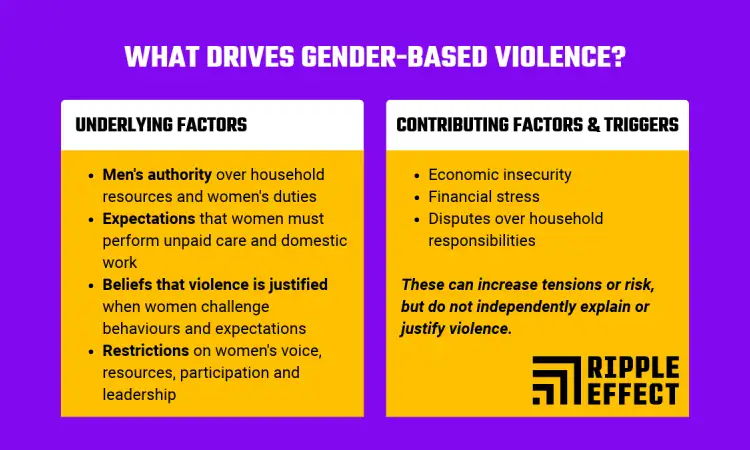
Gender-based violence refers to harmful acts committed against someone because of their gender. Violence against women and girls can take many forms, including physical abuse, sexual violence, psychological harm and economic abuse. Although GBV occurs in every society, its underlying drivers are closely linked to gender inequality and the misuse of power.
In the rural communities where we work in East Africa, traditional expectations can reinforce men's authority over household resources and women's behaviour. Women can be expected to fulfil domestic responsibilities without question, while men are usually automatically given greater control over financial decisions.
Economic insecurity often amplifies tensions within households, but it is important to distinguish between the circumstances that may trigger conflict and the beliefs that allow violence to be considered acceptable. Our research in Western Kenya revealed that some men considered violence justified when they believed their wives had neglected their household duties. This shows that violence against women goes beyond economic circumstances, and prevention requires changing the expectations and power relations that allow violence to be justified in the first place.
What our research revealed about intimate partner violence
Between 2018 and 2020, Ripple Effect, then known as Send a Cow, partnered with the Global Women's Institute at George Washington University to investigate how our gender-transformative approaches influenced attitudes towards and experiences of intimate partner violence (IPV) in Western Kenya. The research included qualitative discussions with community members and a quantitative survey involving 274 women and 96 men.
It revealed the extent of violence experienced by women participating in our programmes. Overall, 71% of women surveyed reported having experienced some form of intimate partner violence.
The findings also provided encouraging evidence of changes reported following programme participation. Among women who had experienced physical violence, 36% reported that it had stopped, while a further 32% reported that it had decreased. Participants also described improvements in household relationships, including more respectful communication and greater involvement by women in decision-making.
These findings are significant because they demonstrate how an integrated rural development programme can contribute to addressing some of the conditions associated with violence against women.
However, the research also highlighted the complexity of changing deeply rooted gender norms. Some women continued to experience violence, while a small proportion reported an increase.
The study relied on women's retrospective accounts of changes in violence, so its findings should not be interpreted as definitive proof that the programme caused the reductions reported.
For Ripple Effect, this evidence has helped inform how we strengthen our gender-transformative work, particularly the need to engage men in challenging controlling behaviour and to ensure safeguarding remains central to programme delivery.
Our approach to changing power dynamics within the home
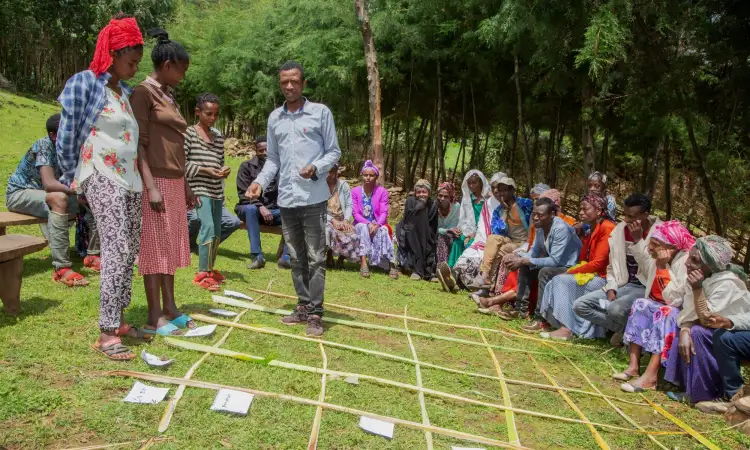
One of the ways we put gender equality into practice at a household level is through our Transformative Household Methodology (THM). THM is a participatory approach that brings family members together to examine how responsibiliies and decision-making power are shared.
Rather than prescribing solutions, facilitators support families to identify inequalities themselves and develop practical action plans for change after some time for reflection. For example, a family might recognise that a woman spends much of her day working on the farm and completing domestic tasks, while her husband makes most of the decisions about the income generated. Discussion facilitated around this can bring up repressed feelings and build a common understanding between family members, from which point they begin to question why those responsibilities and decisions are divided in that way.
Men and boys are encouraged to take a more active role in domestic work, while women and girls are supported to participate more fully in household decisions. These changes can be significant because they challenge the assumption that household responsibilities and authority should be determined by gender.
Our programmes have recorded substantial improvements in these areas:
- Ethiopia: in our Developing Businesswomen project (2019-2022), 90% of women reported a more equitable distribution of household tasks, compared with 26% at baseline.
- Kenya: in our Enterprising Migori project (2020-2024), women's involvement in decisions about major household expenditure increased from 33% to 86%.
- Burundi: in our Gender and Nutrition-Centered Agriculture Phase II project (2021-2024), women's participation in household decision-making increased from 43% to 78%.
These results demonstrate meaningful progress towards more equitable household relationships, supported by our THM approach. Although they are not direct measures of violence reduction, they show how families can begin to challenge the unequal distribution of power that contributes to gender inequality and intimate partner violence, together.
Our approach to changing attitudes across communities
Household-level change is essential, but the beliefs that sustain violence are also shaped by the wider community. If inequality and violence is tolerated or excused by neighbours or community leaders, changing attitudes within individual households becomes more difficult. This is why Ripple Effect's work extends beyond the home.
Alongside THM, our programmes have used SASA! Together, a community mobilisation methodology developed by Raising Voices, that encourages people to examine how power operates and how it can be used to create positive change.
Peer Farmer Trainers and community champions facilitate discussions with women and men about harmful gender norms and violence. These conversations create opportunities for people to recognise practices they may previously have accepted as normal, including intimate partner violence and early marriage. Men are encouraged to reflect on how they exercise power and the role they can play in creating more equitable relationships.
Community leaders are also important in challenging harmful expectations and encouraging wider participation. In Mount Elgon, Kenya, community dialogues have brought these issues into the open. Jackline, the chairwoman of the local Women Group, described how attitudes towards GBV had changed in her community following the group's involvement with Ripple Effect. She recalled that approximately 20 cases of GBV had previously been reported each month, whereas more recently, months had passed without a reported case.
This is a powerful account of change experienced by a community member, although reported cases alone cannot establish the true prevalence of violence. Fear and barriers to reporting can affect whether incidents become known.
What matters is that communities are increasingly recognising harmful practices and taking responsibility for challenging them. And more than that, through Ripple Effect programmes, men are sharing more decision-making with women and are often seeing the benefits of their wives’ choices, giving them a new perspective of women’s value in decision-making and income-generation within the household and community.
Reducing gender-based violence by addressing financial triggers
Alongside challenging the unequal power dynamics that enable violence, Ripple Effect also works to address economic insecurity, which can increase tensions within households and trigger gender-based violence.
Our Economic and Social Empowerment (EASE) approach brings together sustainable farming, enterprise development, and gender and social inclusion. By combining these areas, we support farming families to build reliable livelihoods while supporting women to participate equally in the opportunities and income their farms generate.
Through training in sustainable farming practices, families learn how to improve their harvests and grow a greater variety of crops. Enterprise development helps them turn surplus produce into income, creating opportunities to invest in their farms and meet household needs.
For women, this often means developing their own income-generating activities and gaining greater financial independence. Combined with our gender-transformative approaches, it usually also strengthens their influence over how household resources are used.
These changes matter because financial pressures can contribute to conflict within families. Improving household income and women's economic opportunities can help reduce some of these pressures, while more equitable decision-making encourages families to manage their resources together.
Economic insecurity is not the root cause of gender-based violence, and greater financial security does not guarantee protection from abuse. But by addressing economic pressures alongside the harmful gender norms that enable violence, our EASE approach tackles interconnected challenges that affect women's wellbeing.
Making communities safer through safeguarding and specialist partnerships
Preventing gender-based violence also means ensuring that people who experience abuse know where they can seek help. Ripple Effect's community-led safeguarding approach supports communities to identify safeguarding concerns and strengthen connections with appropriate support services.
We work with community groups to map available referral services and build relationships with relevant authorities and specialist organisations. These include government offices responsible for women and children's protection and other organisations providing support to survivors. The aim is to help communities understand what support is available and how to access it safely.
Ripple Effect also maintains organisational safeguarding reporting mechanisms, including country-level reporting lines for concerns connected to our staff, partners or activities.
An important part of our approach is recognising the limits of our role. Ripple Effect is not a specialist GBV case management or counselling organisation. We do not provide medical treatment or emergency accommodation for survivors. Instead, we work to strengthen prevention through community engagement and connect people with organisations that have the expertise to respond to violence.
Partnerships with women's rights organisations are therefore essential to our work. Our experience includes collaboration with organisations such as the Centre for Rights Education and Awareness (CREAW) in Kenya, Women Empowerment Action in Ethiopia and Fontaine Isoko in Burundi. These partnerships help bring specialist knowledge into wider efforts to challenge gender inequality and support safer communities.
What does lasting change require?
One of the clearest lessons from our experience is that transforming gender relations requires sustained engagement.
Changing how a family shares responsibilities is an important step. But challenging beliefs about male authority and women's roles can be more difficult, particularly when those beliefs are reinforced by wider social expectations.
Our work has shown the value of involving men and boys directly, rather than expecting women to challenge inequality alone. It has also reinforced the importance of working with community leaders who can influence local attitudes and support positive change. And it has shown why safeguarding must be considered in development programmes. Changes in women's economic opportunities and decision-making power need to be accompanied by careful attention to the risks they may face.
There is no single intervention that will end violence against women.
Ripple Effect's contribution lies in combining practical economic opportunities with approaches that challenge unequal power relations, supported by community-led action and partnerships with specialist organisations.
Our experience demonstrates that agricultural development can do more than improve farming practices or household income. When gender equality is built into how programmes are designed and delivered, it can also contribute to changing the relationships that shape women's everyday lives.
Support change that goes beyond the farm
At Ripple Effect, we believe that thriving rural communities depend on everyone having the opportunity to participate and benefit equally. When women have greater influence over household decisions and communities challenge the acceptance of violence, the benefits of development can reach further.
Our Equal Roots Fund brings this work together to address the inequalities that limit women's opportunities. If you would like to support this area of our work, you can learn more about the fund and make a donation.
Or, you can support our work more broadly in different ways:

Want to hear good news stories from Africa, get involved in fantastic fundraising and be part of exciting events? Fill out your details below and we will keep you updated by email.