

Innovations to reduce and redistribute unpaid care work in Kenya and Ethiopia
Approx. 5 min read
By Winnifred Mailu, Head of Thematic Support and Capacity Building
As the world marks International Women’s Day on 8 March 2026, Ripple Effect celebrates the progress made in advancing gender equality while recognising the continued efforts needed to ensure women and girls live empowered and fulfilling lives.
Ripple Effect’s gender work focuses not only on improving women’s economic opportunities, but also on ensuring women have the time, confidence, and support needed to thrive.
This year’s United Nations theme, “Rights. Justice. Action. For All Women and Girls,” highlights the urgent need to remove structural barriers that limit women’s opportunities. One of the most persistent of these barriers is the disproportionate burden of unpaid care work carried by women and girls.
The hidden burden of unpaid care work
Across many African communities, women are expected to shoulder most household and caregiving responsibilities.
These tasks include preparing food, fetching water, gathering firewood, caring for children and elderly family members, and supporting family livelihoods. Although these activities are essential to the wellbeing of families and communities, they are rarely recognised as productive work because they are unpaid and socially expected.
In rural areas of Kenya and Ethiopia, women and girls involved in smallholder livestock systems face particularly heavy workloads. A significant portion of their time is spent providing livestock feed and water – activities that are essential for rural households that depend on livestock for food and income.
According to estimates from the World Bank, women in these communities may spend up to 16 hours per day performing unpaid care work. This heavy workload limits their ability to participate in income-generating activities, community leadership, education, and personal wellbeing.
The situation is further exacerbated by limited access to labour-saving technologies and services such as childcare.
Scaling innovations to address the challenge
Care work is the backbone of households and societies, yet it often remains invisible, unpaid, and undervalued.
To help address this challenge, Ripple Effect, with funding from the International Development Research Centre (IDRC), is implementing the Scaling Innovations for Reduced and Redistributed Women’s Unpaid Care Work (I4RR) project in partnership with the International Livestock Research Institute (ILRI), Centre for Rights Education and Awareness (CREAW), Women Empowerment Action and We Effect.,
The three-year initiative (2024–2027) is being implemented in Bungoma County in Kenya and the Wolayta region of Ethiopia, where the partners are working with communities to test practical solutions that reduce women’s workloads and promote a more equitable sharing of unpaid care responsibilities within households.
Through these efforts, the project aims to lighten women’s workload while contributing to shifting gender norms toward a more equitable division of care work.
Practical innovations that reduce workload
The project aims to enhance the empowerment of women and girls involved in smallholder livestock systems by introducing practical innovations that reduce workload and encourage more equitable sharing of responsibilities within households.
Gender-transformative approaches are used to challenge deep-rooted norms that place disproportionate responsibilities on women.
Through the Transformative Household Methodology (THM), families analyse how household tasks are distributed and identify ways to share responsibilities more fairly. Community dialogues based on the SASA! model (Start, Awareness, Support, and Action) also create spaces where community members reflect on gender roles and promote equality within households.
These approaches are helping women feel more empowered and aware of their rights, while encouraging households to share care responsibilities more fairly.
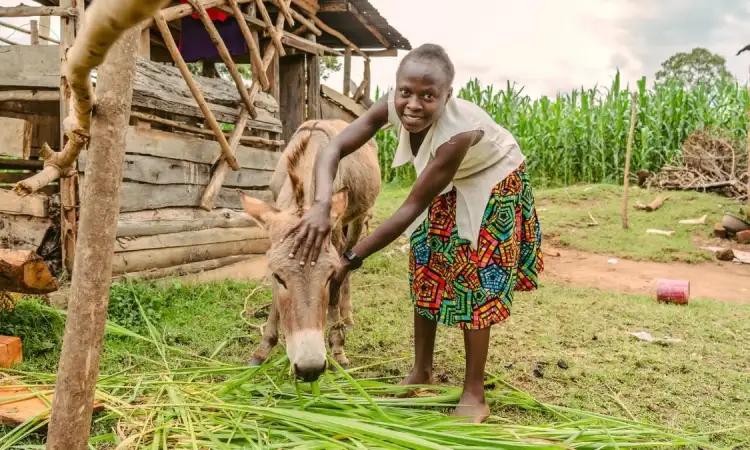
The project also promotes the use of donkeys to transport livestock forage and water from fields to homes. Traditionally, women carry heavy loads over long distances. Integrating donkeys into farming systems significantly reduces the physical strain and time required for this task.
Improved forage production is another key intervention. By introducing high-quality forage varieties that can be grown closer to home, farmers can produce enough livestock feed within their own production systems, reducing the need to travel long distances to collect feed.
The project ultimately focuses on reducing women’s workload at household level, enabling them to spend more time engaging in economic activities and participating in their communities.
Want to hear good news stories from Africa, get involved in fantastic fundraising and be part of exciting events? Fill out your details below and we will keep you updated by email.