

Navigating the winds of change: how Ripple Effect is adapting to non-profit sector challenges
Approx. 10 min read
By Paul Stuart, CEO at Ripple Effect
Non-profit organisations are not only facing growing pressures, they are being asked to adapt how they work in response. As funding tightens and climate shocks intensify, organisations must find new ways to stay effective, accountable and locally rooted.
In our earlier article, Navigating the winds of change: challenges facing the non-profit sector we explored the forces driving this shift, drawing on discussions at the World Food Programme Annual Partnership Consultation and Ripple Effect’s experience across rural Africa.
In this article we share insight on what we're doing at Ripple Effect to reduce the impact of the pressures we, as many others in the industry, face. From localisation and partnerships, to digital learning and farmer-led influence, our various approaches aim to sustain and grow our progress, to ultimately support farming families in rural Africa in building long-term resilience and change as best we can.
Adjusting our sails: how we’re responding to global industry pressures
Many of the pressures we face aren’t new, but the scale and speed are increasing. That’s why it’s so important that we remain part of sector-wide discussions, learn from others, and keep adapting how we work even as our core mission stays the same.
Localisation and Africa Forward Together
Ripple Effect’s Africa Forward Together vision aligns closely with the direction set out at the APC. By shifting more programme leadership, expertise and decision-making to our Africa Hub and Country Programme teams, we’re integgrating local knowledge into the design and delivery of our programmes.
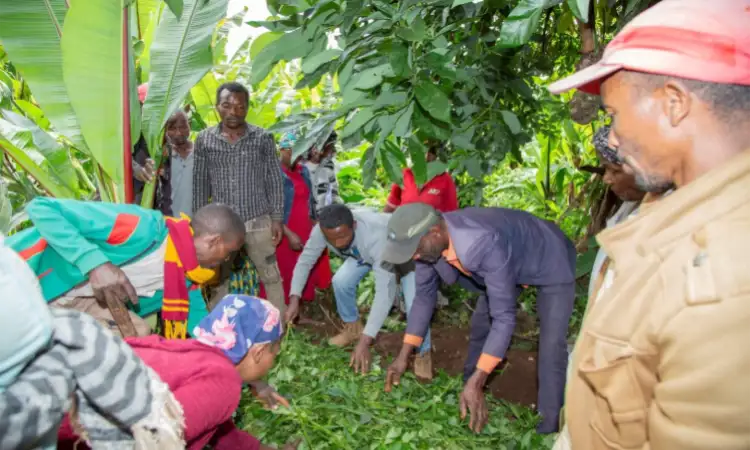
Alongside this internal shift, localisation also means working through strong local delivery partners. Our collaboration with the Zambian Rainbow Development Foundation (ZRDF) shows how locally rooted partners can lead training, reach more farmers and build long-term capacity in ways that international organisations can’t do alone.
At community level, localisation comes to life through Self Help Groups, Village Savings and Loan Associations and peer farmer networks. These groups enable farmers to lead their own progress, share knowledge, and create solutions that last. This approach requires patience and investment but is essential for locally driven impact and resilience to the global pressures shaping the wider sector.
Partnership as a core strategy
Partnerships are already central to our delivery model. In Zambia, our collaboration with our local delivery partner, ZRDF, enabled peer farmers to reach 3,296 households last year with practical training in sustainable agriculture and regenerative farming.
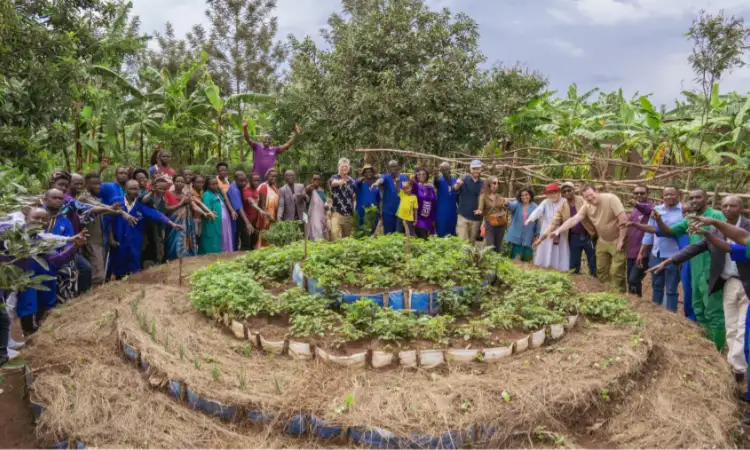
Our work with trusts and foundations is equally important. A £1.1 million grant from the Isle of Man Government is supporting communities in Burundi and Rwanda to regenerate degraded land and strengthen food security. This is one example of how long-term funding partnerships help sustain our programmes.
Corporate partners also play a vital role. Through our partnership with the World Food Programme on the Agriculture and Market Support (AMS) project, over 24,000 young people in southwestern Uganda have been supported to start, grow and sustain agricultural enterprises, with many accessing inclusive markets for the first time. This support helps young people build skills, income and longer-term financial security. These partnerships sit alongside others across our work, all contributing in different ways to our wider impact.
Together, partnerships increase our reach and strengthen our programmes, but they still rely on stable funding and long-term commitment.
If your organisation is interested in supporting sustainable food systems and communities in rural Africa, please get in touch. We would love to speak with you about what a partnership with us could look like.
Funding for a more uncertain future
To respond to a more volatile funding environment, we’re diversifying how we raise income. Ripple Effect US will invest further in fundraising from 2026, helping us reach new supporters. We’re also developing three thematic funds so that individuals, companies and institutions can support the specific area of our work they feel most connected to, while still giving us some flexibility to allocate funds where they are most needed
Legacy gifts continue to make a significant difference. Last year, supporters who included Ripple Effect in their Will contributed £711,588 in vital unrestricted funding, helping protect projects during a period of rising costs. Leave a gift in your Will, or find out more about legacy giving.
Our match-funded appeals also played a major role. Through partnerships with generous major donors, supporters were able to double the impact of their donations, helping raise nearly £398,000 across our summer and Christmas appeals.
Together, these contributions have been essential during a challenging year, and we are deeply grateful. Your continued support remains vital for us to stand alongside farming families and protect the progress they are making.
If you would like to support our work, you can donate today, explore our charity gifts, or discover other ways to get involved.
Strengthening digital monitoring and learning
One of the challenges raised at the APC was the difficulty of sharing real-time evidence from remote areas, especially when digital infrastructure is limited. Our Monitoring and Evaluation team has been addressing this through the introduction of Activity Info, a secure, web-based platform, currently being tested in our Boresha Mazingira project in West Pokot, Kenya.
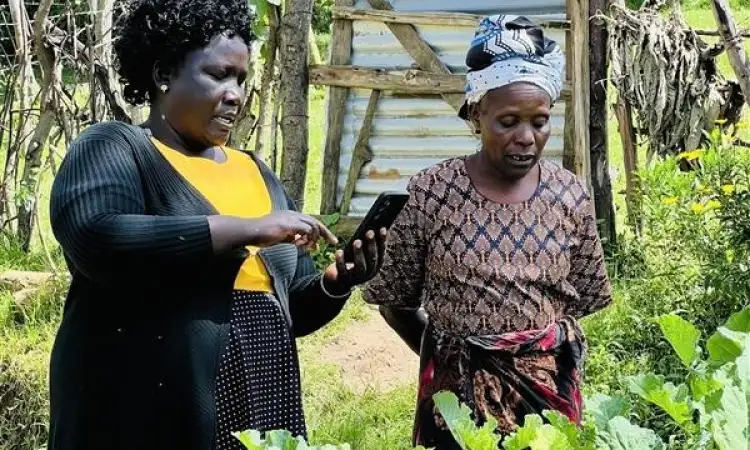
Peer Farmer Trainers are now using project-provided phones and the Activity Info application to record what is happening in their groups. This includes registering farmers, tracking the inputs distributed to them and documenting the sustainable farming practices they adopt.
Lucy, one of the Peer Farmer Trainers, recently visited Veronica, a farmer in her group, to see how she was applying the techniques she had learned. As they walked through Veronica’s farm, Lucy used her phone to record changes in soil conservation, crop diversity and kitchen gardens directly into the system. For them, it was a practical conversation about what was working. For the wider team, it provided timely data that could be used for project reporting, learning and decision making.
Digital tools like Activity Info strengthen our accountability and help us demonstrate our projects’ impact to donors. They also require sustained investment in connectivity, devices and training so that they remain useful and accessible for field teams.
Community participation and cross border learning
Community participation and trust underpin all of our work, and they take time to build and strengthen. Many farmers are cautious about joining new projects, sometimes because past initiatives created expectations of payment or offered short-term support. This is why our teams take time to listen, build relationships, and understand concerns before training begins.
To help build confidence, we arrange exchange visits, so that individuals who are unsure can visit other farms and see the results for themselves. Speaking directly to a farmer who has already adopted new practices helps them understand the long-term benefits and visualise what this change could look like for their own families.
Cross-border learning also strengthens our programmes. For instance, our Country Director in Ethiopia, Melesse Berhanu, and our Country Director in Kenya, Titus Sagala exchanged roles for a month to gain insights on what is working well in each country’s context and learn from one another’s approaches. These insights help us operate as one organisation, even across different environments and regulatory systems.
Working closely with local government structures is also an important part of our approach, helping to ensure that programmes are understood, supported and aligned with community priorities. In our Restore project in Rwanda and Burundi for example, early hesitation from some local administrators shifted to active support through dialogue and joint planning. They went on to allocate protected land near Lake Cyohoha for nurseries that now supply seedlings to restore soil and rebuild local ecosystems.
These experiences highlight the importance of working together across country programmes, with communities and government bodies, and approaching challenges with empathy, openness and a commitment to continuous learning.
Influence and farmer voices
As an international development charity, our responsibility goes beyond delivering programmes - our duty is also to advocate for change and influence decision makers and policymakers. Our global colleagues regularly participate in sector discussions through conferences, webinars, podcasts and publications, sharing evidence and learnings from our work.
But this year, we wanted to directly amplify the voice of one of the farmers we work with. Violet Natembeya, a smallholder farmer from a programme in Kenya, spoke on behalf of her community when she was invited to share evidence to a UK parliamentary committee as part of the UK Government’s work on SDG2: Zero Hunger. She described the realities of farming on the frontline of the climate crisis - unpredictable weather, poor soils and the daily struggle to secure enough food for her family.
Violet also shared how Ripple Effect training helped her diversify crops, improve soil health and begin building a food-secure future. Her testimony demonstrated the impact of sustainable, locally led agriculture and highlighted why the voices of farmers must be part of national and global discussions on food systems and climate change.
How you can support us
Across our programmes, farming families are working hard to adapt to climate change, build food security and grow small enterprises. Our teams are adjusting our sails through localisation, partnerships, digital innovation and farmer-led influence. These efforts are making a real difference.
At the same time, the wider context is becoming more challenging. Funding cuts, climate shocks and rising costs mean that progress is never guaranteed. The work we do to overcome these challenges makes a difference, but we still really need your support to sustain it and to reach more people.
You can help by:
- Donating to support sustainable agriculture, gender equality and enterprise development in rural Africa
- Choosing charity gifts that help farming families grow food and income as an alternative to traditional presents
- Leaving a gift in your Will, so that future generations can benefit from long- term support
- Partnering with us through your company, church, school or community group
- Signing up to our newsletter and sharing stories like Violet’s within your networks
Every act of support, whether it is a regular donation, a legacy pledge, or simply talking about us with your family and friends, is part of a wider ripple effect that reaches far beyond a single project.
Together, we can continue to stand alongside farming families and work toward a confident, thriving and sustainable rural Africa.
Want to hear good news stories from Africa, get involved in fantastic fundraising and be part of exciting events? Fill out your details below and we will keep you updated by email.